On the Toad (Still)
On error, drift, and symbolic encounter. An exploration of how meaning forms beyond accuracy, and what it means to navigate without a map.

For reasons I still don’t fully understand, my phone has been autocorrecting the word road to toad for years. Not once or twice, mind you, but consistently. “Let me know when you’re on the toad.” “I’m almost on the toad.” At some point I stopped fixing it and started adding the little frog emoji behind it. 🐸… Oddly, no one asked for clarification. People around me seemed to translate automatically, and somehow, almost magically, meaning held.
I think about that toad error more than it probably deserves, definitely every time it repeats. Maybe because it’s clever and gives me a chuckle, but maybe also because it’s instructive. I didn’t decide that toad meant road. I let the system drift. Others adjusted and reality didn’t fracture. The messages arrive anyway.
“In a time when reality seems increasingly to be shaped by witnessing, capturing, re-presenting, and interpreting, perhaps orientation matters more than accuracy. ”
That pattern has been on my mind as I’ve been rereading an old essay I wrote several years ago, one that began as an academic exercise and sort of quietly turned into something else. That kind of drift seems to happen pretty often in my creative life. Anyway, the essay was an attempt to understand a symbol in a fairy tale: a carpet so exquisite that a king was willing to judge the fitness of one of his heirs based on its quality. I did what I know how to do. I researched, and read, and followed scholarly threads until they dissolved into very predictable contradictions. I got lost in reflexivity. I made errors and missed pages while reading the source material. And somewhere in all that wandering, meaning appeared like magic anyway, not in the form of a conclusion, but as something closer to a lived encounter.
Revisiting that essay now, what lingers with me isn’t the interpretation I arrived at. It’s how I arrived. Reason (and the academic approach) did its job and then reached a boundary. I wouldn’t say the approach failed so much as it just…stopped. It answered many of my questions, but it could not return, what I was seeking (the meaning of that carpet as a symbol) because, naturally, meaning is often just beyond the territorial boundary line of reason.
Far from being a catastrophe, that limit created an opening. Another form of navigation came online, not method exactly, and not quite intuition either. Instead, it was one that read the signals of error, chance, and questing, and sent me retracing my steps right back to where I started, standing on my own home territory. Something that looks suspiciously like the the Self, acting as orientation rather than authority.
Here was a case of stepping outside institutional methods of investigation, which often arrive at a loose constellation of meanings and park there ambivalently. Meaning, in this case, emerged because I stayed with the symbol long enough for it to reorganize my perspective (or perhaps, at worst, by accident). The experience wasn’t universally verifiable, repeatable, or scientific, but it was reliable precisely because it located me. That locating — that sense of arriving somewhere even without a map — feels increasingly important.
We tend to treat the limits of reason as a problem still to be solved or even dismissed, but there is another possibility. When reason reaches its edge and something meaningful still appears, perhaps we’re not witnessing a failure of understanding, but the opportunity for other forms of knowing to take the wheel. This isn’t an argument for abandoning rational thought, but for recognizing that some kinds of understanding simply aren’t reachable using the tools we’ve already mastered.
The fairy tale in question didn’t explain the carpet. It enacted it. It made it storied, and, as readers, we quested after the carpet alongside its meaning. My old essay (limited though it may be) tried to translate that encounter into language. Reading it now, I can see it for what it really is, a record of consciousness moving through uncertainty without collapsing, because, despite the loss of its map, something or someone was still navigating.
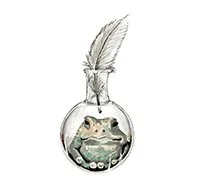
Which brings me back to the toad.
Errors happen. Systems drift, technology misbehaves, and still, we move inevitably toward meaning. In a time when reality seems increasingly to be shaped by witnessing, capturing, re-presenting, and interpreting, perhaps orientation matters more than accuracy. Perhaps being on the toad, and willing to continue without correcting every deviation, isn’t a failure of rigor, but a different kind of fidelity.
I don’t know exactly where that leaves me, philosophically or otherwise. but I’m increasingly willing to trust that when reason reaches its limit and something coherent still emerges, the path hasn’t vanished. The GPS signal may just be bouncing off some invisible points within—and without.
Wherever I am, for now, I seem still to be on the toad.